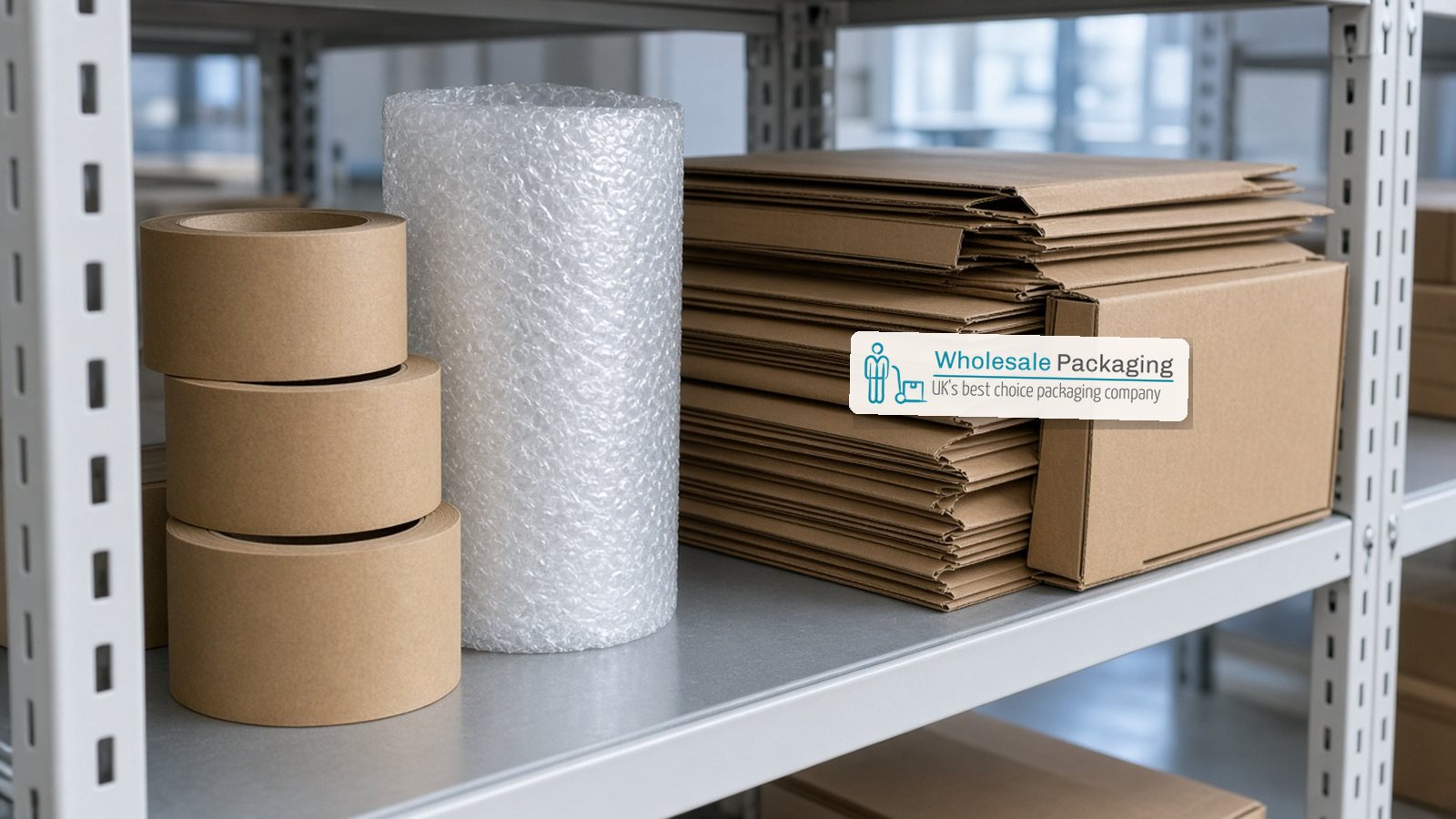
One size of carton, not a sample of every size
A first stock fails when it is a catalogue in miniature. You cannot learn a dispatch desk by owning one of every carton. Measure the goods you actually send most often, then buy the box closest to that size, in a quantity you can store and use. Single wall is the everyday board: the category describes it as strong, affordable and versatile. Move to double wall, manufactured in the UK, only if those goods are heavy, fragile or will be stacked. A first order of double wall “just in case”, in a size you have not measured, becomes a pile of the wrong carton.
If you send two clearly different shapes, buy two sizes, not six. A flat book and a boxed product are different packs. A book wrap is the flat one. A cube is the boxed one. Choosing a cardboard box walks the ranges. Packing a mixed dispatch is how those lines are used together once they arrive. The first order is the smaller decision: the minimum that lets you send the main product without improvising.
Write the size down as the category prints it, and note whether you measured the goods or the outside of a carton you already liked. The two numbers are not the same. When the first batch runs out, you reorder that line, not “a similar box”. The product pages are pack quantities of one size. Pick the quantity that matches a few weeks of orders if you have the room, or a shorter run if you are still unsure of the size.
One tape, one cushion, one fill
Add a tape that suits the board you bought. Brown or clear packing tape closes an ordinary carton. Gummed paper tape is the water-activated paper seal, described as recycled, biodegradable and recyclable, and it wants the dispenser that wets it. A first desk that has never used gummed tape should start with a packing tape and a tape gun if the volume justifies it, and try gummed paper on a later order. Vinyl and printed tapes can wait until a heavy carton or a handling message asks for them. Tapes is the whole list. You do not need the whole list on day one.
Add a cushion only if something you send can break. Bubble wrap in one type, small or large, is enough to learn with. Biodegradable bubble and paper bubble are the alternatives when you already know you do not want standard plastic. Foam and corner guards are the next order, if the first parcels show a corner that the roll does not cover. Do not buy every protection line before you have seen what actually gets damaged.
Add a fill if the carton is not a perfect fit. Paper void fill or loose fill takes the gap. Ecoflo peanuts are the corn-starch version named on the eco-friendly page. Fill is not a substitute for buying a closer carton next time. If the first week shows you are pouring a lot of fill into every parcel, the carton is the thing to change on the second order, not the fill.
What to leave until a job asks
Postal tubes, wardrobe boxes, archive boxes, pallet boxes, strapping and stretch wrap are real products. They are the wrong first stock if you do not send rolls, hanging clothes, files, export pallets or banded bundles. Buying them “to have the range” ties up money and space. When a job appears, order that line then. Orders placed by 3pm are dispatched the same day, so a special is not a month-long wait. The terms aim for 5.30pm the next working day, and a 1 to 3 day courier is also described.
White postal boxes and crash lock boxes are worth a first order only if the goods and the postal size already match them. Crash lock sizes are the six listed on that category, on 150K/T board, with a peel-and-seal strip. If your product does not sit in one of those sizes, a plain carton is the honest first buy. Amazon FBA and Amazon Shipping cartons follow maximums we publish for those programmes. They are a first stock only if you are actually sending on that programme. Otherwise they are a later, separate order.
Poly mailers are the right first outer for soft goods that do not need walls. They are the wrong first outer for anything rigid. If you are unsure, pack one sample of the real product before you buy a case. A case of the wrong mailer is the same mistake as a pallet of the wrong carton, just smaller.
How the first basket is paid for and delivered
UK delivery is free when the goods total is over £50 ex VAT. A first stock of a carton quantity, a pack of tape and a roll of wrap often clears that on its own. If it does not, add the fill you know you will use, rather than a product you are curious about. An order under £50 still leaves. It is not held. Checkout does not need an account. Card, PayPal, Apple Pay and Google Pay are the methods. Delivery is the page to read before you assume a pallet will arrive like a small parcel.
TradePro is worth applying for when you already know you will reorder, not as a discount on a speculative first basket. It is for trade businesses, starts at 5% off, and goes up to 10% over £1,000 a month. It adds BACS. A new desk that has not yet proved the carton size should pay the standard way, confirm the pack, then apply. Same-day dispatch explains the 3pm cutoff the first order will actually travel on. Place it on a Monday, Tuesday, Wednesday or Thursday morning if you want the next-working-day aim to be the following day. A Friday order aims for Monday.
Stocked items can be returned within 14 days of purchase if the size was wrong. Call and arrange it. That is a reason to buy a modest first quantity of an untried size, not a reason to buy every size. Keep the packaging the goods arrived in if you might send it back, and do not print or tape a carton you still might return. Mixed dispatch points at the other notes once this first stock is in the building and you are packing with it rather than shopping for it.