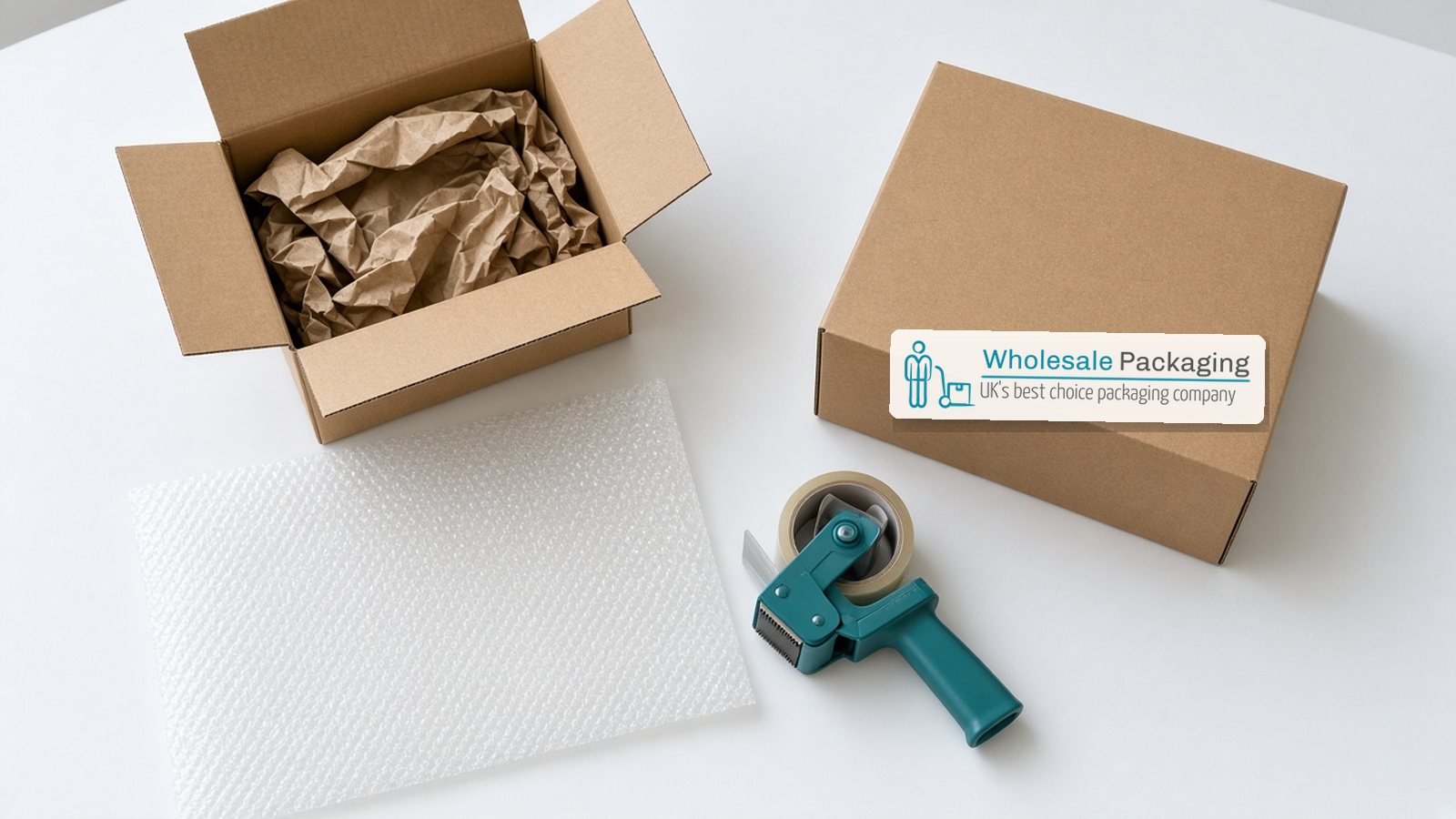
Decide the outer before the padding
A mixed dispatch is a parcel that needs more than a carton. Most of them do. The carton is still the first choice, because the padding is there to protect what the carton does not. Start with the goods. Measure the length, the width and the height, including anything that cannot be folded. Then open Boxes and look for a size close to that measurement. A carton that is much larger than the goods forces you to buy fill you would not have needed. A carton that is tight presses the corners of the goods against the board.
Single wall boxes are described as strong, affordable and versatile. That is the everyday outer for a normal dispatch weight. Double wall boxes are the stronger board, manufactured in the UK, for goods that are heavy, valuable or fragile, and for a carton that will be stacked. A bigger single wall carton is not a stronger carton. If the contents are heavy, change the board, not only the size. The longer note on that choice is Choosing a cardboard box.
Some goods are not a cube. A book can take a book wrap. A poster can take a tube. A garment that must stay on a hanger takes a wardrobe box with a rail. Those are separate ranges because the shape of the goods is the shape of the pack. Putting a flat book in a deep carton, then filling the depth, is the long way round.
Cushion the face that can break
Bubble wrap is for a fragile face or a corner. It is not the material that fills a half-empty carton. The bubble wrap guide separates the two jobs, and the category lists small bubble, large bubble, green biodegradable bubble and paper bubble. Small bubble follows a tighter surface. Large bubble is the heavier cushion. The green biodegradable wrap and the paper version are the alternatives when you do not want standard plastic bubble. Bubble pouches are the bag form, for a single item that should be bagged rather than rolled.
Cover the fragile faces so the layer meets at the edges. A loose sheet that stops short of a corner does not cushion that corner. Glass, ceramics and a framed picture often need a sheet and then a corner piece. Foam wrap is the soft continuous sheet, listed for glass, crockery and electronics. Edge and corner protection is the guard for the point a sheet leaves open. Use the one that matches the shape. Do not expect wrap, on its own, to stop a heavy item sliding inside a carton that is too big.
Fill the space you could not avoid
If the goods can move, the carton is still too big, or the goods are an awkward shape and a closer carton does not exist. That gap is a void-fill job. Loose fill, paper void fill and the corn-starch peanuts described on the eco-friendly page take up the empty space. Paper void fill is listed as recycled and recyclable. The peanuts are biodegradable. They are not a substitute for a closer carton, and they are not a cushion for a fragile face. Wrap first, then fill, if the goods need both.
A mixed order can hold the carton, the wrap and the fill together. That is the point of buying them from one shop. The void fill, bubble and tape guide is the short version of how those three lines sit next to each other. Open loose fill or paper void fill for the product, rather than guessing that bubble will do the filling.
Close it so the lid stays a lid
Tape is the seal. Fill and wrap do not close a carton. Tapes includes brown packing tape, clear tape and gummed paper tape. Gummed paper tape is the water-activated tape, described as 100% recycled paper, biodegradable and recyclable, with a strong seal on corrugated board. The category names the Xtegra water-activated range, in standard and reinforced versions, and the dispensers that wet the tape. A crash lock box is the exception on one seam: that range has a peel-and-seal strip, so that particular close does not need a separate tape.
Run the tape across the seam, not only along the middle of the lid, and continue it down the sides far enough that the flaps cannot peel. A heavy double wall carton can need a stronger tape than a light postal box. Vinyl and crossweave tapes sit in the same tapes category for that job. Printed tapes, including fragile messages, are also listed there if the outside of the carton needs a handling note. The tape does not change the strength of the board.
Check the outside if it is going by post
If the parcel is a Royal Mail small parcel, the outside of the finished pack is what counts, including the tape and any bulge from an overfilled carton. Our Royal Mail changes page gives the current small parcel maximum as 450 mm long, 350 mm wide and 160 mm deep, and it says those figures are external dimensions. A roll can still be a small parcel at up to 450 mm long and 80 mm in diameter. A small parcel costs less to send than a standard parcel for people and businesses sending fewer than 1,000 parcels a year.
A carton that is right for the goods but over those figures is a different, dearer parcel. White postal boxes are described as qualifying as Royal Mail small parcels, in white 125WK/T, and some are shell-and-slide packs with foam. They are still subject to that outside maximum. The postal packaging guide lists the other compliant sizes we stock. Measure the made-up carton, not the goods, before you commit a large reorder to one size.
The basket leaves as one order
Cartons, wrap, fill and tape placed together use one dispatch rule. Orders placed by 3pm are dispatched the same day. The terms aim for delivery by 5.30pm the next working day. Monday to Thursday, that is the next day. Friday aims for the following Monday. A bank holiday on Friday or Monday moves the delivery to the next working day after that. Weekends are not dispatch days. The homepage also describes a 1 to 3 day courier, depending on the items, so a time-sensitive bench should plan for the later of the two.
UK delivery is free on orders over £50 ex VAT. The figure is the goods total before VAT. Putting the lines on one order is how a small run of cartons and a roll of tape reach that threshold together. An order under it still leaves. It is not held for being small. Stocked items can be returned within 14 days of purchase. The delivery page is the place to read the service before a large or awkward consignment.
When the same pack happens every week
A desk that sends the same size every day should write the size down once it works: the board, the internal fit, and whether the outside still counts as a small parcel. Reorder that size, not a larger one “to be safe”. The product pages are that carton in different pack quantities. Order the quantity you will actually send.
TradePro is the trade account for a business that reorders. It starts at 5% off and goes up to 10% when spend is over £1,000 a month. Membership is for trade businesses. It adds BACS as well as card and PayPal, priority support and trade-only offers. A one-off buyer does not need it. Card, PayPal, Apple Pay and Google Pay work at checkout without an account. The account changes the price and the way you pay. It does not change the 3pm cutoff. If you are buying the lines for the first time, a first stock of packaging is the shopping list, and mixed dispatch collects the shorter notes around this one.